New hearing technology was on show in Hannover, from adaptive sound processing to audio streaming in public spaces. A vote in the German parliament during the congress prompted concern over patient choice and continuity of care.
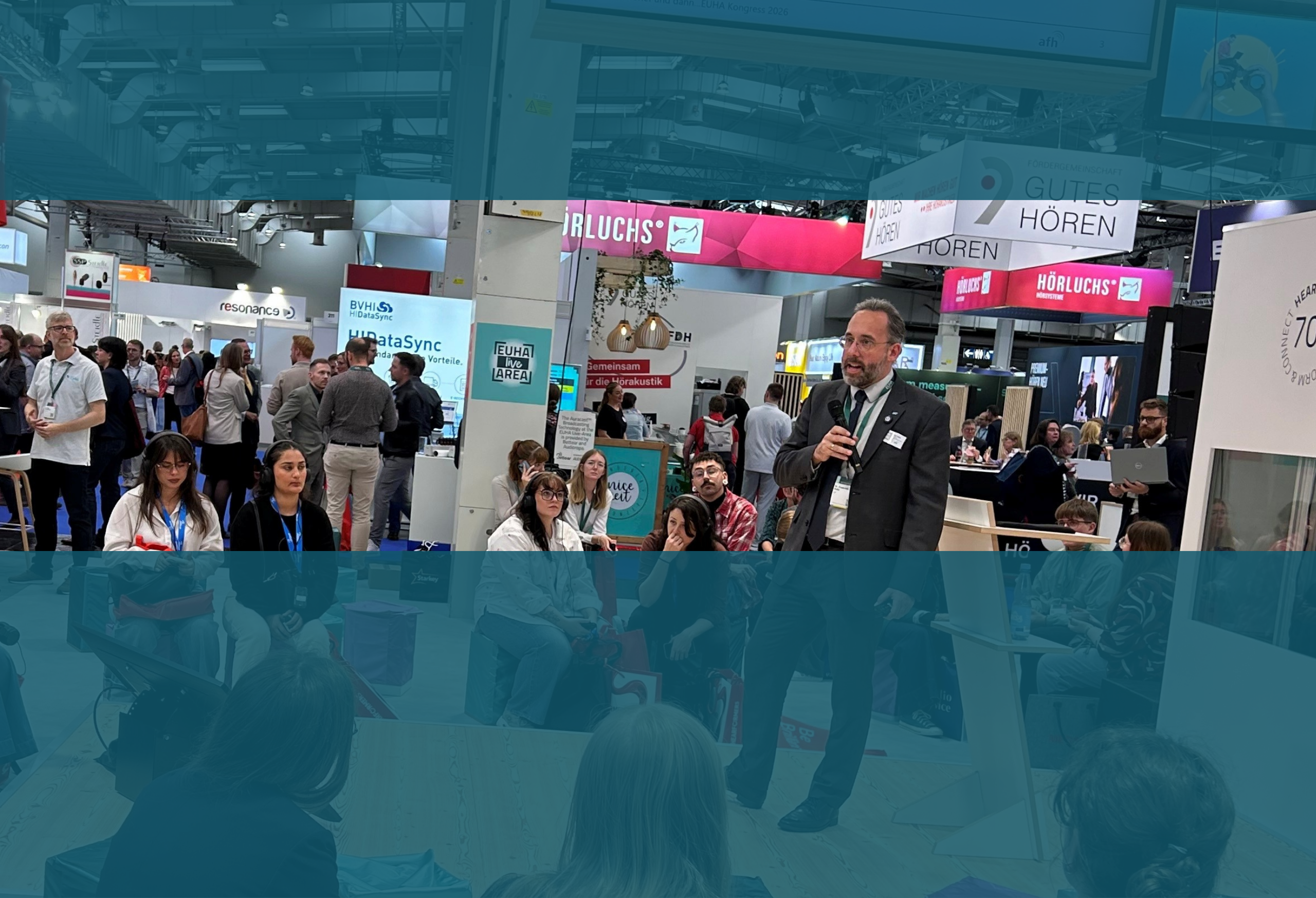
From 14 to 16 October, Hannover hosted the 70th EUHA Congress and its accompanying industry exhibition. More than 140 exhibitors from 22 countries presented their products and services, with demonstrations giving visitors a chance to explore how the technology works. The Netherlands was this year’s partner country.
Sound processing and everyday use
Following a conversation in a noisy room remains a central challenge for hearing aid users. AI-based processing featured prominently at the exhibition, with systems designed to separate speech from competing noise and adapt as the listening situation changes. Developers are also working on the balance between speech clarity and useful environmental sound, so that wearers can follow a conversation while retaining a sense of their surroundings.
More efficient processors are bringing complex sound processing into smaller, lighter hearing aids. New developments were also presented in wireless connectivity, remote microphones that can pick up speech closer to the speaker, and cochlear implant sound processors.
Audio in public spaces
Auracast broadcast audio was another focus of the exhibition and Live Area program. At equipped venues, it can transmit announcements or event audio directly to compatible hearing aids and other receivers, reducing the effects of distance, background noise and reverberation.
A Live Area presentation examined experience from a pilot introduced at Frankfurt Airport in January 2026. At two gates, passengers could receive announcements directly on compatible personal devices.
Digital tools for hearing care practices
HIDataSync, the digital interface developed by the German Hearing Industry Association (BVHI) and its member companies, had its own stand for the first time. It allows hearing care professionals to import manufacturers’ product information into their existing business software, reducing manual data transfer. The platform also provides interfaces for ordering, delivery notes and electronic invoices, which software providers and manufacturers are integrating step by step.
Fitting demonstrations let visitors adjust settings on connected hearing aids and hear the difference. A congress lecture also addressed how to verify the effects of noise reduction through acoustic measurements. In the Live Area, industry and university presentations sat alongside practical sessions, including Friday’s program on AI in day-to-day business.
The debate over hearing care
On 15 October, the second day of the exhibition, the German Bundestag approved provisions that would allow statutory health insurers to use competitive tendering for medical aids again under specified conditions. The provisions include quality safeguards and state that tendering is generally unsuitable for care involving a high proportion of individually delivered services, but they do not explicitly exempt hearing care.
Seven members of Germany’s Hearing Health Initiative issued a joint statement opposing tendering in hearing care. Their concern is the effect on a service that combines medical assessment, the selection and fitting of suitable devices, and reliable support over many years. They warn that tendering could restrict patient choice, disrupt established care relationships and make local support harder to access.
BVHI and its partners are calling for hearing care to be explicitly excluded from tendering. The statement was also sent to Germany’s state health ministers ahead of further consideration by the Bundesrat, which represents the federal states.
For policymakers in Germany and beyond, the issue is how to preserve access to both suitable technology and the expertise needed to make it work for each person. EUHA 2026 demonstrated the industry’s capacity to advance hearing technology. Protecting the conditions for good care is essential if that progress is to improve communication and participation in everyday life for millions of people living with hearing loss.